

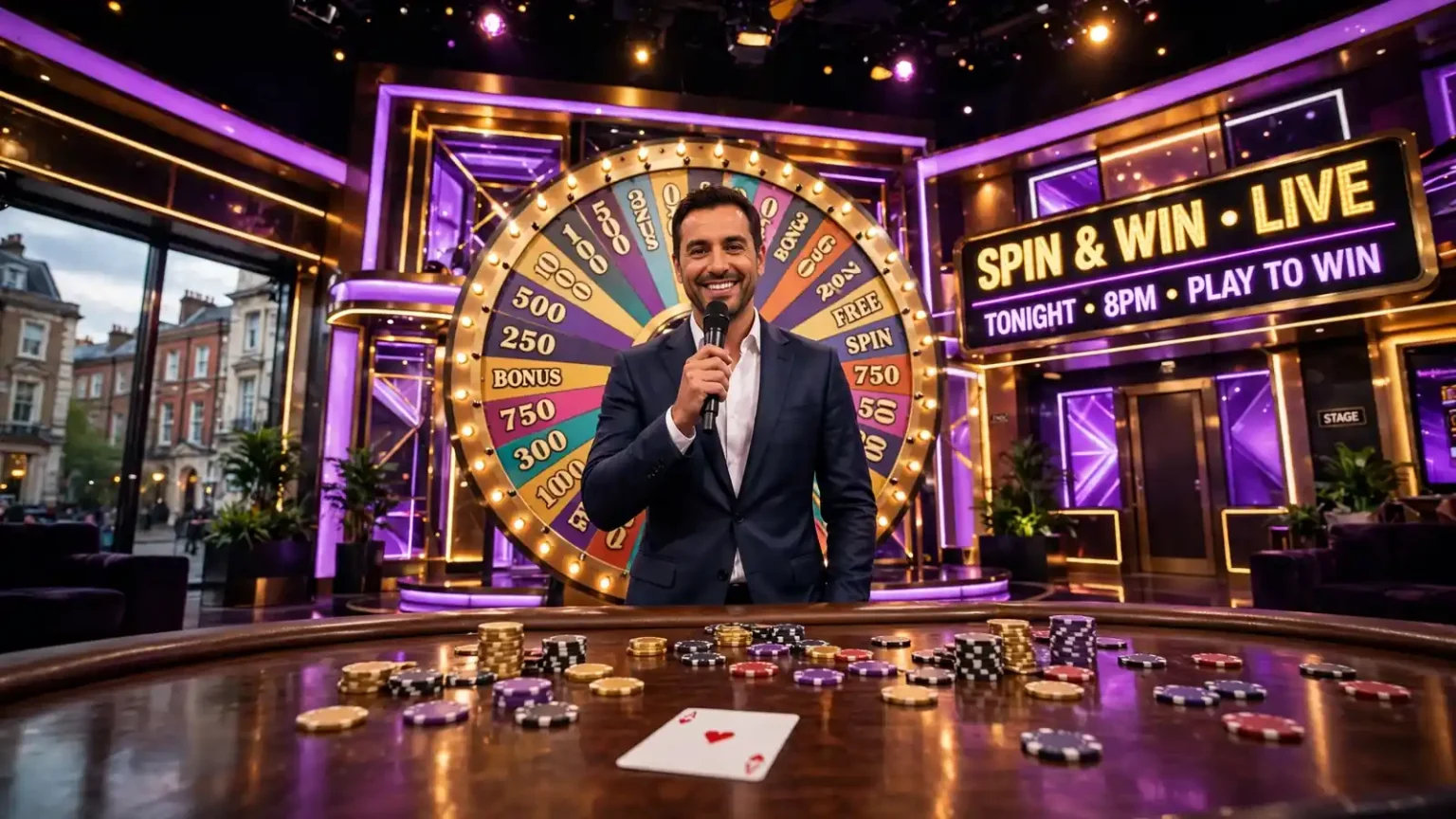
Game-show framing changes how a casino game is presented, but the rules and wager still depend on the specific title.
How Live Casino Game Shows Differ from Standard Casino Games
“Game show” describes a style of casino game, not a guarantee about its rules, pace or presentation. The distinction is useful because a title can borrow the language of entertainment while still involving a wager and an outcome. The format may feel different from a conventional slot or table game, but its appearance alone does not establish how a round works or what a player can win.
A standard casino game is generally recognised by its underlying game type: a slot, a table game or another defined casino format. A live casino game show is instead identified by its game-show framing. That framing can influence how a session is presented and how the game is understood, but it does not remove the need to examine the actual rules. The category label is a starting point, not a substitute for the game’s information.
The difference is in the format, not the wager
A familiar slot interface often puts the game’s central action on the screen: symbols appear, a round resolves, and the result is shown. Table games are usually organised around recognisable procedures, such as a deal, a spin or a sequence of decisions. Those descriptions refer to broad formats; the exact rules still vary by game.
A casino game show can place more emphasis on a show-like frame around the play. That may make the experience feel less like operating a conventional slot or following a traditional table-game layout. But “show-like” is not a precise rule. It does not tell the player what choices are available, how an outcome is determined, whether a round contains separate stages, or how a wager relates to the result.
Those details belong to the game’s rules and pay information. A name, theme or animated presentation cannot answer them. Two games both described as game shows may have different structures, while a game with a familiar casino appearance may still present its action in an unusual way. The category does not make the underlying terms uniform.
Amatic Online Casinos in the UK: Games and Terms
This distinction matters for any comparison of the best online casino game shows in the UK. “Best” cannot be assessed from presentation alone. A useful comparison would need to consider the rules, the permitted betting choices, the way outcomes are settled and the information provided before play. If those details are not clear, a lively screen does not fill the gap. It simply makes the missing information easier to overlook.
What “live” does and does not establish
The word “live” contributes another part of the label, but it should not be treated as a complete description of the game. On its own, it does not specify who or what determines the result, how the action is transmitted, what happens between rounds, or whether the player can influence anything beyond placing a wager. Those are separate questions.
Nor does “live” mean that every online casino game show follows one shared model. The phrase can be used to distinguish a show-oriented experience from a standard digital game, but the name alone cannot verify its technical setup or operating details. Those need to be established from the particular game’s rules and presentation rather than inferred from the words in its title.
The same caution applies to the word “casino”. A game may look like entertainment, but if it involves a stake and a chance-based outcome, its entertainment framing does not make the financial terms incidental. The amount placed at risk, the conditions for a return and the way that return is calculated remain the material parts of the transaction. A game-show setting changes the wrapper; it does not, by itself, change the accounting.
Presentation can change the experience without changing the terms
The format can affect how attention is directed. A conventional game may keep its interface focused on a small set of actions and results. A show-style presentation may give more space to visual cues, narrative or a sense of progression. That contrast is about the way the experience is framed, not a claim that every title uses those elements.
Visual momentum and dramatic sequences do not explain the probability of an outcome or establish that a wager is more favourable.
The practical point is that presentation and mechanics should be read separately. Visual momentum can make a round feel quick or consequential, but it does not explain the probability of an outcome. A sequence that appears dramatic does not establish that a wager is more favourable. A game that feels more interactive does not necessarily offer more control over its result. Those conclusions require rules or other game-specific information.
The same separation applies to perceived value. A feature may be prominent on screen, but its presence does not reveal its contribution to the player’s expected return. Terms such as “bonus”, “feature” or “prize” describe parts of the experience only to the extent that the game rules define them. Without that definition, the word is packaging, not a calculation.
For a financial comparison, the relevant record is more prosaic: what is staked, what outcomes are possible under the rules, and what the game says about payouts. If information is difficult to locate, that is a limitation in the basis for comparison. It should not be replaced with an assumption based on the entertainment style.
A show format is not a game category with standard rules
Casino game shows are often grouped together because the games share a broad presentation idea. That grouping is convenient for browsing, but it does not imply a common rulebook. A category can include games with different round structures, decision points and settlement methods. It can also include titles whose similarities are mostly visual or thematic.
Amatic Games at UK Casinos: Access and Rules
That makes comparisons more demanding than comparing two games that share a clearly defined format. With standard casino games, a familiar label can provide an initial framework: a slot is compared with another slot, or a table game with another version of that table game. Even then, details matter. With game-show titles, the broad label may tell less about the actual play, so the rules carry more weight.
A sensible comparison therefore starts with questions about the individual title rather than assumptions about the category. What is the sequence of play? What action is required from the player? What outcomes are available? How are payouts described? Is the wager attached to one outcome or to several possibilities? The answers are game-specific. The word “show” does not supply them.
This is also why a list of “best live casino game shows” can be misleading if it ranks titles on presentation alone. A ranking may communicate which games a publisher prefers to feature, but it does not automatically establish a better financial proposition. To make a meaningful comparison, the basis for the ranking must be clear and relevant to the player’s decision. Visual appeal and financial terms are different measures.
How to read a game page without filling in the blanks
The game’s own rules are the first place to establish its structure. They should explain how a round proceeds and how the result is settled. Pay information should be read alongside those rules, rather than treated as a decorative panel. Where a term is unfamiliar or a step is unclear, the uncertainty remains; it is not resolved by the game’s genre label.
Do
- Use the game’s own rules to establish structure
- Read pay information alongside the rules
- Identify where the wager is placed
Don’t
- Rely on the genre label to resolve uncertainties
- Treat payout tables as decorative panels
- Confuse theme descriptions with play rules
It is also useful to distinguish between information about the game and information about the experience around it. A description of the theme may explain the intended mood. A rules section should explain play. A payout table or equivalent information should describe returns. Those functions are not interchangeable, even when they appear on the same screen.
For online casino live game shows, the interface can make those boundaries less obvious because the game may be presented as a continuous entertainment experience. The player still needs to identify where the wager is placed, when a round is considered complete and what conditions determine any payout. If those points are not apparent, a polished presentation offers no accounting advantage.
The same discipline applies to claims about pace or engagement. An energetic format might feel more absorbing than a conventional game, but that is a matter of presentation and individual response, not proof of a favourable return. The amount of screen activity does not measure the financial quality of play. A busy interface is still an interface.
What separates these games from slots and table games
The distinction is best understood as one of emphasis. Standard casino games are commonly classified by their core play format. Game shows are identified by a show-oriented presentation layered over wagering. That description does not establish that every title combines the same ingredients, or that every game marketed in this way works alike.
A slot comparison usually centres on its game rules, symbols, features and payout information. A table-game comparison centres on its procedure, available decisions and settlement rules. For a show-style title, those same practical matters remain necessary, but the presentation may provide less immediate guidance about the underlying structure. The game must be assessed on what its rules actually say.
Betsoft Casinos in the UK: Licensing and Evidence
This difference can also affect expectations. Someone familiar with slots might expect a particular pattern of play; someone familiar with televised game shows might expect contestants, a host or a familiar sequence. Neither expectation should be carried over automatically to an online casino game. The name may evoke an existing entertainment format without reproducing its rules or roles.
A clear review of a title should therefore separate confirmed game details from impressions about its theme. “Interactive”, “fast-paced” and “immersive” are descriptions of experience, not measures of odds or returns. They may help explain the design, but they cannot replace information about how the wager works. When a claim cannot be tied to a rule or stated term, it should not be treated as a financial fact.
Choosing by information rather than atmosphere
The appeal of live casino game shows is not difficult to understand: the format offers a different presentation from the familiar visual language of slots and traditional table games. That difference can be enough to make a category worth exploring. It is not enough to judge a particular game’s terms.
A practical assessment separates three questions. First, what does the game look and feel like? Second, what does the player do during a round? Third, what financial outcome does each result produce under the stated rules? The first question concerns presentation. The next two concern the game itself. A description that answers only the first does not support a complete comparison.
Practical Assessment
- Separate visual style from player actions
- Distinguish presentation from financial outcomes
- Avoid treating entertainment value as evidence of financial value
- Rely on the title’s published terms rather than the broad category label
That approach avoids a common category error: treating entertainment value as evidence of financial value. The two can coexist, but one does not establish the other. A game can be visually distinctive and still have rules that require close reading. Conversely, a simple-looking interface does not by itself establish that a game is easier to assess or more favourable.
The phrase “online casino game shows” is therefore broad. It covers a style of presentation, not a single set of mechanics. Some distinctions from standard casino games are visible in the experience; the material differences are found in each title’s rules and payout terms. The label can help locate the type of entertainment being offered. It cannot settle the calculation.
Recommended online casinos
- BritsinoBonus: Welcome Package – Get your £2,200 + 2,000 FS · Payout speed: 1-3 business days
- DieselwinBonus: Welcome Pack 250% up to £4000 + 200 FS · Payout speed: 1-3 business days
- WinBeastBonus: €5000 + 500 FS + €650 Freebet · Payout speed: 1-3 business days
- AmunbetBonus: Join now and get 450% up to 2,700 GBP + 450 FS · Payout speed: 1-3 business days
- ZombillionBonus: Welcome Pack 250% up to £4000 + 200 FS · Payout speed: 1-3 business days
- NightWinBonus: £900 + 400 free spins · Payout speed: 1-3 business days
- x3betBonus: Welcome Pack 100% Up to £1.000 + 200 Free Spins · Payout speed: 1-3 business days
- NightLuckBonus: Welcome Pack + 805% Up To 6400€ + 280 FS · Payout speed: 1-3 business days
- JetsetspinsBonus: 200% Bonus + 100 Free Spins + Free Royal Wheel · Payout speed: 1-3 business days
UK Casinos, Game-Show Availability and the Regulatory Boundary
Finding a live game show in a UK-facing casino involves two separate questions: whether a particular operator makes the title available, and whether the gambling service is operating within the relevant regulatory framework. Those questions should not be collapsed into one. A casino’s general presence in the market does not establish that it offers a particular show, while a game listing alone does not establish the regulatory status of the service carrying it.
Online Casinos with No Limits: UK Rules Explained
The distinction matters because “live game shows” describes a category of casino entertainment, not a single product supplied in the same way by every operator. A search for online casinos with live game shows may return casino pages, game pages and promotional material, but those labels do not amount to a confirmed catalogue. A specific title can only be treated as available where the operator’s own current information establishes that it is offered through that service.
Availability is an operator-level question
The UK casino market is regulated at the level of gambling activity and the businesses that provide it. The Gambling Commission oversees commercial gambling in Great Britain, including remote services offered to consumers there. Its remit over remote gambling does not depend on the physical location of the equipment used to provide the service. A company cannot place key equipment elsewhere and thereby remove a Great Britain-facing remote gambling service from the Commission’s regulatory scope.
Barcrest online casinos in the UK: what is verified
That rule defines the boundary of regulation; it does not certify every item shown in a casino lobby. A UKGC licence and a live game-show listing answer different questions. The licence concerns the business and its authorised activity. The listing concerns whether a particular game is currently presented through that operator. A general statement that a casino is licensed is therefore not evidence that it carries any named live show.
The reverse is also true. A page displaying the name or image of a game does not, by itself, establish that the casino holds the relevant UKGC operating licence. Product presentation and regulatory status should be assessed separately. Treating one as proof of the other is a convenient shortcut, but it is not a sound check.
For anyone comparing live game shows casinos in the UK, the practical distinction is between a market-level description and an operator-level fact. “Offers live casino games” may refer to a broad part of a site’s catalogue; it does not necessarily confirm a particular show. A page about a named title may describe the product without proving that the title is available to customers through every casino mentioned on that page. Availability claims need to be specific to the operator and current to the service being described.
Regulatory Scope
A UKGC licence concerns the business and its authorised activity, while a game listing only indicates whether a specific title is currently presented by that operator.
This is why a general list of online casinos with live game shows cannot be treated as a stable register of products. The regulatory register concerns licensed businesses and their permissions, not a complete live inventory of each casino’s games. The Commission’s role is regulatory; it is not a catalogue service that confirms every show carried by every operator.
What the UKGC licence establishes
The UK Gambling Commission issues operating licences to businesses and personal licences to individuals who perform relevant roles in Great Britain. These are different permissions for different subjects. An operating licence applies to a business conducting gambling activity. A personal licence applies to an individual operating in the regulated environment. Neither should be confused with a game title, a studio label or a casino’s editorial description of its catalogue.
For remote gambling offered to consumers in Great Britain, the operator’s location does not decide whether the Commission’s rules apply. The relevant point is that the service is being offered to consumers in the regulated market. This prevents the physical location of technical equipment from being mistaken for a substitute for the operator’s regulatory obligations.
The Commission is the sole regulator for commercial gambling in Great Britain. That gives the UKGC operating licence its central role when assessing whether a real-money casino service is authorised for that market. It does not mean that a licence is a guarantee about a particular game’s presence, the quality of its presentation or its suitability for an individual customer. Those are separate matters and should not be folded into the meaning of the licence.
Amatic Games at New UK Online Casinos: How Access Works
There is also a geographic distinction within the United Kingdom. The Gambling Act 2005 governs gambling in England, Wales and Scotland, but not Northern Ireland. The Commission’s stated role as the sole regulator for commercial gambling applies to Great Britain. It is therefore more precise to describe the Commission’s remote-gambling framework in relation to Great Britain consumers than to treat every part of the UK as having an identical legal arrangement.
For the same reason, a UK-facing description should not use “UK casino” as though it were a regulatory category that proves an operator’s status. The phrase may be used informally to describe a casino aimed at British customers. The legally relevant check is whether the business holds the appropriate UKGC operating licence for the activity it offers. The wording on a landing page is not a substitute for that status.
Separating a casino’s claims from its licence status
A useful assessment keeps three records distinct: the operator’s regulatory position, the services covered by its permissions, and the games currently presented to customers. The first concerns the business. The second concerns the scope of its authorised activity. The third concerns the current product offer. These records may sit in different places and serve different purposes; one cannot safely stand in for the others.
Regulatory Check
An operator’s licence is not confirmation that every game category is present, and a game listing is not proof that the operator holds the relevant UKGC operating licence.
In particular, an operator’s licence should not be read as confirmation that every game category is present. A casino may be authorised to conduct remote gambling while its public-facing pages describe a narrower or changing selection. Equally, a page that refers to live entertainment may not identify which titles are accessible through the account or in the relevant jurisdiction. The exact distinction depends on the operator’s own current presentation, not on the broad category name.
The term “best live game shows casinos” also combines a subjective ranking with a factual availability question. A ranking requires criteria: for example, the breadth of a verified catalogue or the clarity of product information.
A more defensible standard is narrower. A casino can be described as carrying a particular show only when current operator information supports that statement. Its regulatory position should then be checked independently against the Gambling Commission’s records. A general licence reference does not fill a gap in the catalogue evidence, and a catalogue entry does not fill a gap in the regulatory check.
This separation also limits what can be inferred from third-party casino pages. A review, comparison page or promotional description may use broad language about live games. Unless it identifies the operator and the relevant title clearly, it cannot establish a specific match. Even a precise title reference should be treated as a product claim, not as proof of licensing. The two checks remain separate because they answer different questions.
Amatic Slots at UK Online Casinos: What to Know
Remote gambling and the location of equipment
The location-neutral part of the Commission’s remit is important in a remote setting. Online services rely on technical systems that may be distributed across locations. For Great Britain consumers, the location of the key equipment does not, by itself, determine whether the remote gambling activity falls within the Commission’s regulatory scope. The operator’s obligations cannot be avoided simply by locating equipment outside Great Britain.
This boundary is about the service offered to consumers, not a claim that the Commission regulates every gambling activity everywhere. It applies to remote gambling offered into the Great Britain market. The distinction is useful when a casino’s corporate address, technical infrastructure or marketing material points to another country: none of those details alone resolves the question of whether the relevant UKGC operating licence is required.
Likewise, the presence of a live-show interface does not change the basic regulatory analysis. Whether a game is presented through a studio-style broadcast, a casino lobby or another online format, the key question for market access remains the authorisation of the business offering remote gambling to Great Britain consumers. The format may matter to the product description, but it does not replace the operator-level licensing boundary.
Reading claims about UK availability
A careful description of live game shows online casinos should use language proportionate to the evidence. “Available at this operator” is a claim about a current catalogue. “The operator is licensed” is a claim about regulatory status. “The market offers live game shows” is broader still and should not be used to imply that every casino has the same titles.
Verifying Casino Services
- Confirm the title is currently available at the specific operator
- Check the operator’s UKGC operating licence status
- Verify that the product is authorised for Great Britain consumers
- Separate marketing claims from the actual game catalogue
For consumers comparing services, the distinction is financial as well as editorial. A casino’s marketing page can create an expectation about a product, while the actual catalogue determines what is accessible through that service. The cost of treating a broad category label as a specific availability promise is wasted comparison: the licence may be genuine, yet the desired title may not be listed. The reverse mismatch is also possible—a visible game reference does not establish that the operator is authorised to offer it to Great Britain customers.
The regulatory boundary can therefore be stated clearly without turning it into a catalogue claim. The UKGC regulates commercial gambling in Great Britain and oversees remote gambling offered to consumers there, regardless of where the key equipment is situated. It issues operating licences to businesses and personal licences to individuals. Those facts establish who regulates the market and the kinds of permissions involved; they do not identify which casino carries any particular live game show.
For live game-show availability, the operator’s current product information remains the relevant evidence. For regulatory status, the operator’s UKGC position is the relevant evidence. Keeping those checks separate avoids the two common errors: assuming a licence confirms a game listing, or assuming a game listing confirms a licence.
Crazy Time and Funky Time: What the Search Terms Cover
Crazy Time and Funky Time are names that can lead to searches for particular casino game shows. A name, however, is not a full description of a product. It does not establish how a game works, whether it is live, which company supplies it, or where it can be played. Those details need to be confirmed separately rather than inferred from the wording of a title.
Amatic Online Casinos in the UK: Games and Access
That distinction matters because a search for a named show can return material about different things: the game itself, a casino’s description of it, commentary about it, or a page using the name as a broad label. These are not interchangeable. A promotional description may summarise a product without setting out its complete rules; a discussion page may reflect an individual’s account rather than current product information. The title is a starting point, not a specification.
What a title does—and does not—tell you
The phrase “Crazy Time” may identify the subject a person intends to find, but it cannot by itself establish whether the product is a live casino game show. The same applies to “Funky Time”. The words do not disclose the game’s format, any underlying rules, the role of a presenter, or how a result is determined. Those points require product-specific information.
Nor does a title establish commercial details. It does not show whether a particular casino carries the game, whether access is available to a given account, or what conditions apply to play. A casino listing, where one exists, is a separate piece of information from the product name. Availability can be time-sensitive, so an old mention or a page with no clear date should not be treated as confirmation of present access.
The same caution applies to claims about features. A title does not prove that a game has particular bonus rounds, multipliers, betting options, or other mechanics. Those are rules, not implications of branding. Any such claim should be tied to the current game information supplied by the relevant operator or product provider. If that information is not available, the feature should not be assumed.
Product Identity
A game title like "Crazy Time" or "Funky Time" is a starting point for identification, but it does not disclose the game’s format, rules, or commercial availability.
How to read descriptions
A useful description should make clear which product it refers to and distinguish confirmed rules from promotional language. Terms such as “live”, “show”, or “interactive” can be used loosely in summaries. Their presence alone does not explain what happens during play or how a result is produced. The decisive information is the game’s own rules and the current details presented with it.
The same standard applies to claims about the people or technology involved. A name or short description is not enough to identify a host, studio, software supplier, or operating arrangement. These details should not be filled in from a familiar-sounding brand or from assumptions about other casino shows. Similar labels do not mean identical products.
This is particularly important when several pages repeat the same short description. Repetition can make a claim look settled without providing additional evidence. A page that names a game is not necessarily an authoritative source for its rules; a page that lists rules should still be checked for which version or operator it describes. The practical test is whether the information is specific to the named title and clear about its scope.
Keeping the decision grounded
For Crazy Time or Funky Time, the useful sequence is straightforward: identify the exact game, read its current rules, and separate those rules from claims about where it can be played. A product page can clarify the first points; the casino’s own information is needed for account-specific terms. Neither should be replaced by assumptions drawn from the title.
Wazdan Casinos in the UK: What Can Be Verified
This also avoids confusing a game’s identity with its commercial presentation. A casino may describe a product in its own words, while a third-party page may use a shortened or promotional label. Differences in wording do not necessarily prove that the products differ, but neither do they prove that they are the same. The exact title and accompanying product details need to align.
There is no sound basis for ranking these two names, comparing their mechanics, or describing one as more suitable than the other without dependable, title-specific information. A confident comparison needs comparable inputs: the rules, the way results are determined, and the terms displayed for the relevant product. Without those, a ranking would turn presentation into evidence. The name is useful for locating a subject; it is not a substitute for the terms of play.
Live Casino Game Shows: Scope and Verified Information
The phrase “live casino game show” is broad. It identifies a kind of casino entertainment, but it does not, by itself, establish what a particular game contains or how it works. A title, a promotional description and an operator’s catalogue entry can all use similar language while referring to different products. The label is a starting point for identification, not a complete description of the experience or its terms.
That distinction matters when comparing listings. A useful description needs to say what the game actually offers, rather than relying on the words “live” or “game show” to carry the meaning. Without product-specific information, it is not possible to confirm whether a title has a presenter, uses a studio setting, includes audience interaction, or follows a particular round structure. Those are details to establish from the game’s own information, not assumptions that follow from its category name.
Category Limitations
The label "live casino game show" identifies a style of entertainment but cannot replace the specific rules and payout terms of an individual game.
The same caution applies to claims about outcomes. A game’s presentation does not establish its payout rules, return characteristics, volatility or suitability for a particular budget. These are separate matters, and they should not be inferred from an entertaining format or a prominent promotional description. Where a listing gives no clear terms, the financial calculation remains incomplete.
What a description can establish
A sufficiently detailed game entry can help identify the product and explain its relevant conditions. The practical questions are specific: what counts as a round, how a stake is placed, what outcomes are possible, and how winnings are determined. The answers need to come from the rules or other product information for that title. A broad category description cannot replace them.
The distinction between a game’s presentation and its underlying terms is especially important in casino entertainment. A lively visual format may make the product easier to recognise, but it does not change the need to understand the stake, the possible outcomes and the conditions attached to play. If those details are not stated, there is no sound basis for estimating cost or comparing the game with another.
A catalogue entry also has a limited purpose. It can indicate that an operator lists a product, but it does not independently explain every condition that applies within the game. Descriptions should therefore be read as identification and summary, with the game’s rules providing the detail needed to assess how it operates.
What the category does not prove
The category name does not establish that every product marketed as a live game show shares the same design. It cannot confirm a common set of rules, a standard style of presentation or a consistent method of determining outcomes. Nor does it show that a particular title is available at every casino using the same broad label.
IGT Online Casinos UK: What Listings Verify
Availability and product identity are separate checks. A title may be discussed generally without being listed by a particular operator, and a catalogue may change. A general article about live casino entertainment cannot be treated as a current inventory. The same applies to claims about particular presenters, features or special rounds: those require information tied to the specific game and its current listing.
“Live” also should not be treated as a complete technical description. The word alone does not establish what is broadcast, how the game is operated, or how a player interacts with it. Those points require product-specific explanation. A polished presentation is not a substitute for clear rules; it is packaging, and packaging does not settle the calculation.
A practical way to assess a listing
For a live game-show product, the relevant information is the material that supports an informed comparison: the official title, a plain explanation of play, the rules for stakes and outcomes, and any stated payout information. If the listing links to rules, those rules should match the product being offered. If the wording is promotional but does not explain the terms, it supports recognition of the product, not a financial assessment.
Comparisons are most useful when they separate confirmed details from impressions. Presentation style may be a matter of preference. Rules, stake conditions and payout information are matters of substance. Treating those as different categories prevents a familiar-looking format from being mistaken for a familiar set of terms.
The broad label can therefore answer only a broad question: what kind of casino entertainment is being discussed. It cannot, on its own, identify a particular game’s mechanics, prove its availability or provide the information needed to judge its cost. For a specific live game show, the product name and its own published terms are what make the description concrete.
Are Amatic casinos safe and regulated in the UK?
Amatic Industries holds a UK Gambling Software (Remote) licence, active since 27 April 2017, but it does not operate consumer-facing casinos. The casino operator handling your deposits and payouts must hold the relevant UK licence.
What is Amatic Industries and when was it founded?
Amatic Industries GmbH is an Austrian business-to-business software supplier founded in 1993. It supplies games to casino operators rather than running casinos for consumers.
Are Amatic games licensed and legal to play in the UK?
Yes. Amatic Industries holds a UK Gambling Software (Remote) licence, and its games are distributed to UK players through UKGC-licensed operators.
What are the wagering requirements at Amatic casino bonuses in the UK?
Bonus terms are set by the casino operator, not Amatic. Since 19 December 2025, UK rules cap wagering requirements on bonus funds at 10×.
Material created by the team Skrill Casino UK Guide


