

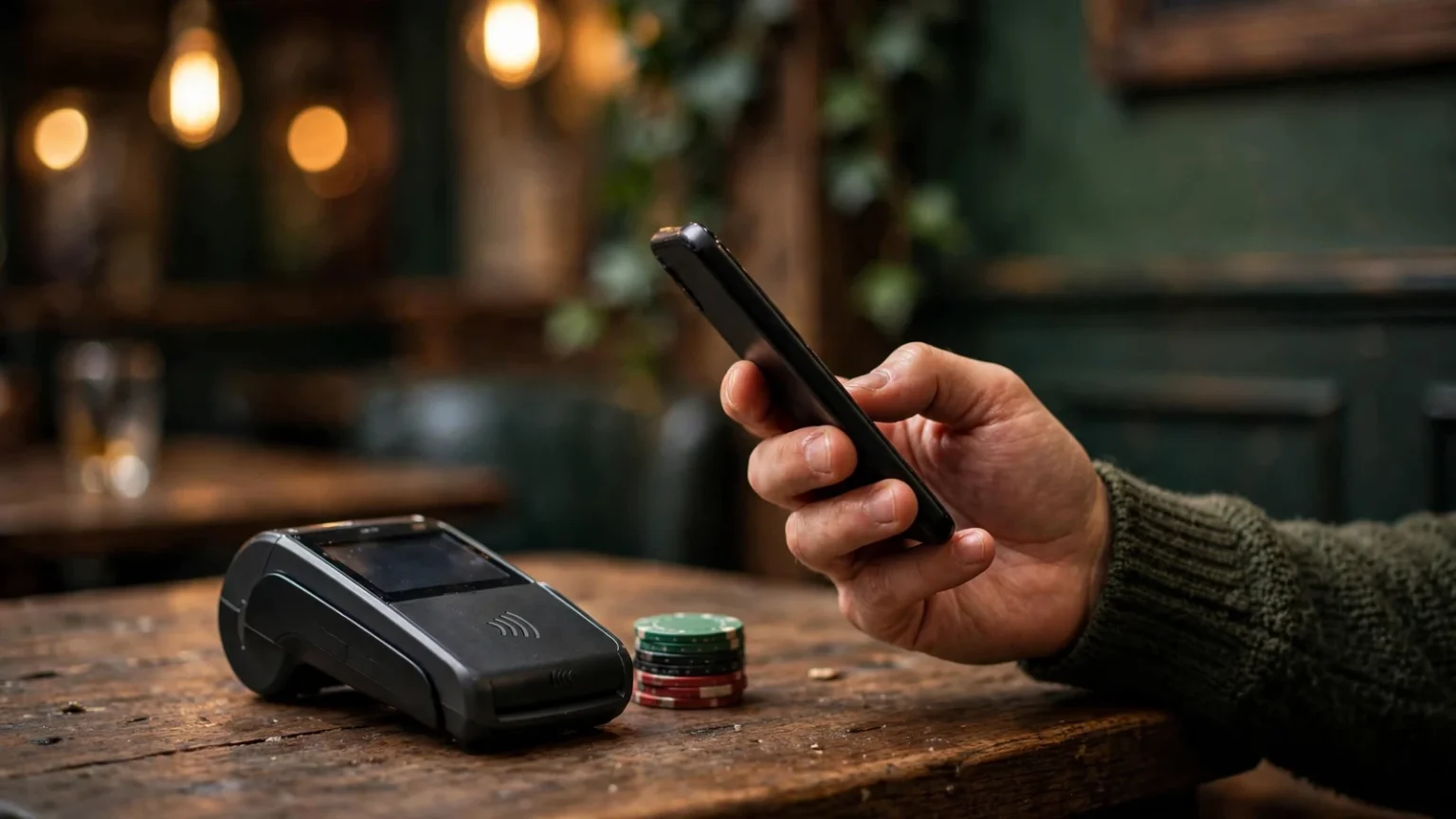
Klarna availability depends on the UK account’s live cashier, while other payment routes can differ in cost, limits, bonus eligibility and payout handling.
Klarna Availability: What Can and Cannot Be Confirmed
Klarna acceptance at a UK casino is a cashier-level detail, not something that can be established from a broad payment-method label or an old promotional page. A site may discuss several ways to pay without identifying Klarna as an available option. Even when a payment brand appears in a review or payment guide, that does not confirm that it is enabled for a particular UK account at the time a deposit is attempted.
That distinction matters for anyone looking for casinos that accept Klarna in the UK in 2026. A dependable confirmation would need to show Klarna as a selectable method in the casino cashier for a UK customer, with the transaction terms displayed before payment. A general reference to instalments, pay-later services or online payments is not equivalent. Nor does a payment method listed for another country establish that the same route works for UK players.
A specialist review may describe payment options, but that description can become outdated as an operator changes its cashier. The relevant check is the live payment screen after the account’s country has been set to the UK. If Klarna is not shown there, an external description is not enough to treat it as currently available. If it is shown, the displayed conditions still determine whether the route can be used for the intended transaction.
The question “Are Klarna casinos still available in the UK?” therefore cannot be answered by treating a brand mention as proof. Availability is specific to the operator, the customer’s location and the cashier configuration at that moment. A casino name associated with Klarna in a previous article may not retain that arrangement. Likewise, the absence of a method from a general landing page does not establish what a logged-in UK cashier will display. The practical evidence is the payment choice presented inside the account before any funds are committed.
Casinos That Accept Litecoin in the UK: Payment Checks
Claims about the “best” Klarna casinos or a complete list carry a further problem: they combine two separate judgements. First, the method must be verifiably available to UK customers. Then the casino would need to be assessed against criteria such as its terms and regulatory status. Without the first step, rankings, bonus comparisons and game recommendations built around Klarna have no stable basis. A list can look precise while relying on a payment label that does not match the live cashier.
The same test applies to newly launched casinos. “New” does not confirm that a payment route is active, and a newly published page does not prove that a cashier has been tested. Availability should be tied to the operator’s current payment screen, rather than inferred from launch language or from a general claim about supported methods. The method should be named clearly, and the screen should apply to the UK account rather than to a different market.
Mobile access does not change that standard. An Android casino may offer a different layout from its desktop site, but the relevant question remains whether Klarna is explicitly presented as an available payment method for the UK account. A mobile-friendly site, an app, or a smooth account interface cannot establish payment acceptance on its own. The device is not the payment evidence.
Casinos That Accept iDEAL in the UK: Payment Checks
There is also a legal boundary around what a UK casino can accept. Remote gambling licensees serving Great Britain must hold the relevant UK Gambling Commission licence. Credit-card payments for gambling are prohibited, including credit-card funding routed through a money service business, and operators cannot accept wallet payments where credit-card funds can be used for gambling. A Klarna label alone does not establish how a particular transaction is funded or whether it meets the operator’s requirements. The cashier’s stated method and conditions matter; a general association with a payment brand does not settle eligibility.
This is why payment availability should not be inferred from the casino’s broader payment list. A specialist review might report Visa and Mastercard among the options, but current UK availability and eligibility for a particular card product still need to be checked in the cashier. The same evidential standard applies to any named method: a list in a review is a lead, not a live confirmation. Payment information has a short shelf life; the cashier is where the present condition is stated.
Do
- Check for Klarna as a selectable method in the live casino cashier
- Verify that transaction terms are displayed before payment
- Ensure the account country is set to the UK
Don’t
- Rely on broad payment-method labels or old promotional pages
- Treat a general reference to pay-later services as confirmation
- Assume availability based on a method listed for another country
A sound confirmation is narrow and specific: the casino serves the UK account, Klarna is visibly selectable in its current cashier, and the relevant transaction terms are shown before submission. Anything less may describe a past arrangement, a different country or a general payment category. That is not enough to establish that a UK customer can deposit with Klarna.
If Klarna Is Unavailable: Other Ways to Pay
When Klarna is not shown in a UK casino’s cashier, the practical alternatives are payment methods the operator actually supports. A method appearing on a general information page is not enough: availability can differ between operators, and the cashier is the relevant check before an account is funded. No payment brand, by itself, identifies a “best” casino or confirms that a particular site accepts it.
Debit cards
Debit cards are the most familiar alternative. UK casinos commonly accept Visa and Mastercard debit cards, so the payment may already be available through a bank account used for ordinary spending. The cashier should still be checked for the particular card product; a logo on an operator page does not establish that every card carrying that brand will work.
A card route also keeps the choice straightforward: the payment is made from the account connected to the card rather than through a separate voucher or e-wallet balance. The relevant comparison at this stage is availability and fit with the casino’s listed options, not an assumption that card payments are automatically preferable. Card eligibility and the separate UK restrictions on credit-card payments are dealt with elsewhere.
Casinos That Accept Solana in the UK: What to Check
Bank transfer and open banking
Bank transfers and open-banking payments provide another route where they appear in the cashier. A specialist review has described these services as supporting immediate deposits and relatively quick withdrawals at many sites; that is a report about services covered by that review, not a guarantee for every casino or bank. The precise route and timing depend on what the operator offers.
The terms “bank transfer” and “open banking” should not be treated as interchangeable labels for one universal product. A cashier may present a named payment service, a direct transfer option, or both. Before selecting one, the useful details are the provider shown, the account information required, and whether the method is available for the intended transaction. A general statement that a casino supports bank payments does not settle those points.
Prepaid vouchers
Paysafecard is a prepaid voucher and is deposit-only. That makes it a different kind of alternative from a card or bank payment: it can fund an account, but it is not a route for receiving money back. Its deposit-only status matters when comparing payment methods, because the ability to put money into an account does not establish that the same method can handle every part of the payment relationship.
A voucher can therefore be considered only where the cashier lists it and its terms suit the intended use. It should not be described as a complete payment option for both directions of a transaction. The distinction is simple, but easy to miss when a payment-method list groups vouchers alongside cards and e-wallets.
E-wallets
Skrill and Neteller are available at some casino sites, rather than across the market. A specialist review identifies Skrill as a commonly used deposit method at UK-facing casino sites in 2026, but that observation does not confirm availability at a particular operator. The cashier remains the point at which an individual site’s current options can be established.
Skrill & Neteller
Commonly used deposit methods at UK-facing casino sites in 2026, though availability varies by operator.
Jeton
Offered by a small number of sites in 2026; availability is selective and can change.
E-wallet General
Adds a separate account between the bank and casino, requiring a check of both the wallet’s and the casino’s terms.
Jeton appears more selectively. A specialist review of UK online casinos reports that the service is still offered by a small number of sites in 2026; the description should not be read as a complete or permanent operator list. Payment menus change, and a service named in a review may not be available to every customer or on every account.
E-wallets add a separate account between the bank and the casino. That may suit someone who already uses the wallet, but it also means checking the wallet’s own terms and the casino’s accepted methods rather than assuming that a familiar brand will be supported. No particular wallet should be treated as a guaranteed substitute for Klarna.
A practical comparison
The options differ chiefly in what they require and what they can do. Debit cards draw on a linked bank account; bank or open-banking services use a bank-based payment route; Paysafecard is a deposit-only voucher; and Skrill, Neteller or Jeton require the relevant e-wallet to be supported by the casino. These descriptions do not establish that every method is available for every customer.
The decision can be reduced to a short check: confirm the method in the cashier, confirm that the account or payment instrument belongs to the customer, and read the operator’s conditions for that route. If an option is absent, another method may be available, but a casino should not be labelled a Klarna alternative solely because it lists a different payment brand. For real-money gambling in Great Britain, the operator must hold the relevant UK Gambling Commission licence; payment branding is not evidence of that status.
Casinos That Accept Ukash in the UK: Current Status
Card Deposits, Credit Rules and Cashier Compatibility
A card logo is not a complete payment rule. Visa and Mastercard appear in specialist casino reviews, but that does not confirm that either network is currently available to every UK customer, or that every card carrying the logo will work. The relevant checks are separate: whether the casino’s cashier offers card deposits, whether the particular card product is eligible, and whether the transaction is treated as a permitted debit-card payment rather than credit-card gambling.
The distinction matters because UK-licensed casinos cannot accept credit-card payments for gambling. The regulator introduced the ban on 14 April 2020, and it remains in force. Remote gambling licensees must also reject credit-card funding routed through a money service business. Changing the route does not change the underlying source of funds.
Debit cards are different. UK casinos commonly accept debit cards, including Visa and Mastercard, but that broad availability does not guarantee acceptance at a particular operator or with a particular card. A cashier may display a network while the card issuer, card type or transaction route still prevents the payment. A card being issued by a familiar bank, or showing a familiar logo, is not enough to establish its eligibility.
This is relevant to searches about using Klarna cards at casinos. The name attached to a card or payment service does not by itself establish whether a casino accepts it, whether it is classified as debit or credit for the transaction, or whether the payment complies with the operator’s rules. Those details depend on the card product and the cashier’s current terms. No general conclusion about Klarna acceptance follows from the presence of Visa or Mastercard in a payment list.
Credit Card Ban
UK-licensed casinos are prohibited from accepting credit-card payments for gambling, including funds routed through money service businesses.
The practical test is therefore product-specific. Before relying on a card, the cashier should be checked for the available card option and its stated conditions; the card’s own terms should be checked to identify how it is funded and classified. If the product involves credit, the gambling-card ban applies. If it is a debit product, acceptance still depends on the casino and the issuer allowing that transaction. A successful payment on one site would not establish acceptance elsewhere.
The same care applies when a card is described as a debit card but has features that could make its funding source unclear. The relevant question is not merely what the card is called in an advertisement. It is whether the payment being made is a debit-card transaction permitted for gambling, rather than credit-card funds reaching the casino by another route. A payment label is not a regulatory workaround.
Casino payment pages can also age faster than general review pages. A listed network may remain on a review page after cashier options have changed, while the cashier may impose conditions not visible in a short payment summary. For that reason, a review can be a starting point for identifying a possible card route, but not proof of current acceptance. The live cashier and the card product’s terms are the controlling checks.
A card deposit and a promotion are separate questions. Card eligibility does not establish entitlement to a bonus, and a bonus advertised in connection with a casino does not make a restricted card acceptable. Likewise, a no-deposit offer has no bearing on whether a card can be used to fund an account. Those conditions should be read independently rather than treated as evidence about the payment method.
For a UK player, the defensible conclusion is narrow: debit-card payments may be available, subject to the operator’s live cashier and the card’s actual classification; credit-card payments for gambling are prohibited at UK-licensed casinos. Visa or Mastercard branding alone proves neither acceptance nor eligibility, and a Klarna association does not alter that test.
UK Casinos That Accept AstroPay: How to Check
Mobile Slots and the Payment Question
A mobile slot game and its payment method are separate parts of a casino account. Playing on a phone does not make Klarna available, and a cashier that lists a payment method does not determine which games appear in the catalogue. The phrase “Klarna slots” therefore describes a hoped-for combination, not a distinct category of slot.
The same distinction applies to online slots played on a mobile device or desktop. Game access is controlled by the casino’s catalogue and the account’s eligibility; payment acceptance is a separate operator decision. A title cannot be identified as a “Klarna game” simply because someone wants to pay for play through Klarna. Availability has to be established at the relevant casino, rather than inferred from a game name or a general payment claim.
“Free slots” also means something different from slots played for real money. A free-play mode, where offered, does not establish that a casino accepts Klarna for deposits, nor does it demonstrate that the same game can be played for cash. Conversely, the presence of a real-money game says nothing about which deposit methods its operator supports. These distinctions matter because promotional wording can combine a payment brand and a game category without proving that both are available together.
The word “legit” needs a separate test. A payment label is not evidence that a casino is legally authorised to serve customers in Great Britain. Remote gambling licensees selling into the British market must hold the relevant UK Gambling Commission licence, irrespective of where the business is based. A casino’s status should be checked on the Commission’s public register before a deposit; the presence of a familiar brand or a mobile-friendly site is not a substitute.
Mobile Slot Regulations
In Britain, autoplay is prohibited, spins must last at least 2.5 seconds, and maximum stakes are capped at £5 (age 25+) or £2 (age 18-24).
Mobile play remains subject to the rules for online slots in Britain. Autoplay is prohibited, each spin must last at least two and a half seconds, and the maximum stake per game cycle depends on the player’s age: £5 for customers aged 25 and over, and £2 for those aged 18 to 24. Those limits apply to the game, not to the phone, payment brand or screen size.
Accordingly, a mobile slot search involving Klarna should be read as two checks: whether the casino offers the desired game for the relevant kind of play, and whether its current payment arrangements support the intended transaction. Neither answer can be derived from the other. A slot shown in a mobile catalogue does not confirm a Klarna route, while a payment option does not guarantee that any particular game is available.
Real-Money Slot Deposits and Payout Timing
A slot deposit and a slot withdrawal are separate stages, with different processing points. The balance may appear quickly after a deposit, but that does not establish how quickly winnings can be paid out. A specialist casino review reports that a card deposit can be instant while a withdrawal takes several business days. The comparison is useful because it shows why “fast payment” is not a complete description: it may refer only to money moving into the account.
For real-money play, the relevant withdrawal clock begins after a payout request is submitted, not when a slot round ends. The casino may first need to review the request internally. A specialist casino review notes that this approval process forms part of the overall processing time and that a first withdrawal can take longer while verification is completed. Any displayed estimate therefore needs to be read as a process estimate, not as a guaranteed arrival time.
Casinos That Accept Boku in the UK: What to Check
Account verification affects the timing because the operator must establish that the account is ready for payment. A specialist casino review identifies both the casino’s internal approval and the account’s verification status as factors in withdrawal speed. If checks remain outstanding, a quick deposit does not remove them or shorten the review. The deposit and payout can therefore have noticeably different timelines even when they relate to the same real-money slot balance.
This distinction matters when assessing claims about playing slots for money through a particular payment service. A payment label alone does not demonstrate that deposits and withdrawals move at the same speed. Nor does a quick deposit confirm that a payout request has been approved or sent. The useful details are the cashier’s stated withdrawal process, the account’s verification status and whether the casino has completed its internal review. Without those details, a deposit-time claim says little about when funds will arrive.
For anyone comparing real-money slot sites, payout timing should be assessed separately from game access and deposit speed. A fast balance update is an incoming transaction; a withdrawal is a request that may still require approval and verification. The distinction is especially relevant at the first payout, when checks can add time. Published timing information should therefore be treated as conditional on the operator’s process and the account being fully verified, rather than as a fixed promise attached to the slot or payment method.
Withdrawal Process
Request Submission
The withdrawal clock begins only after a payout request is submitted.
Internal Review
The casino reviews the request internally, which forms part of the overall processing time.
Account Verification
Verification status is checked to ensure the account is ready for payment, which may extend the timeline for first withdrawals.
Deposits, Withdrawals and Returning Funds to Their Source
A deposit route can shape the way a later payout is handled. For UK gambling accounts, anti-money laundering requirements generally mean that funds are returned to the payment source used to place them. This closed-loop approach helps connect the incoming and outgoing transactions to the same customer; it is not simply a cashier preference.
For that reason, a payment option shown for deposits does not automatically mean that it can receive withdrawals directly. Where an intermediary is involved, the casino may need to establish which account funded the gambling account and whether it belongs to the customer. The payment label alone does not settle that question.
Keeping the casino account details and payment account under the same person’s name reduces the risk of basic ownership mismatches slowing the transaction. A route registered to someone else, or account details that do not align, can create questions even when the deposit itself went through. The operator may then ask for further checks before releasing funds.
If returning a payout through the original route is not possible, another method may be considered, but that can involve additional verification. The exact process depends on the operator and the payment arrangement. A casino cashier’s display of a method therefore says less about the full deposit-to-withdrawal path than its terms on withdrawals and payment ownership.
This distinction matters when assessing searches for Klarna deposits, direct withdrawals or instant banking. A deposit made through a branded service does not establish that winnings can be sent back through that same service, nor that the casino treats it as the underlying funding source. The relevant details are the name of the account holder, the route recorded for the deposit and the operator’s instructions for returning funds.
Casinos That Accept POLi in the UK: What’s Verified
Questions about Klarna’s availability or status in the UK do not, by themselves, establish how a casino would process a payout. Nor does a deposit route determine eligibility for a no-deposit bonus; that is governed by the offer’s own conditions. The transaction path and promotion rules are separate checks.
Before a deposit, the useful confirmation is whether the payment account belongs to the casino customer and how the operator handles a withdrawal if the original route cannot receive it. That is more precise than assuming that a method advertised for deposits also provides a direct way to cash out.
Bonus Eligibility Depends on the Payment Method
A casino welcome offer and the payment method used to fund an account are separate conditions. An offer may be available to eligible customers but exclude deposits made through particular methods. The decisive wording is in the promotion’s terms: check whether the chosen method qualifies before opting in or making a deposit. A payment option appearing in a cashier does not, by itself, establish bonus eligibility.
This distinction matters when assessing claims about Klarna casino welcome bonuses in the UK. The presence of Klarna as a payment option would not prove that a deposit made with it qualifies for a welcome offer, a slots promotion or a bonus code. Eligibility must be stated in the relevant offer terms. The same applies to claims about no-deposit bonuses: those are governed by the promotion’s own conditions, not inferred from the payment method associated with a casino.
Bonus Eligibility
Attention: A payment method appearing in a cashier does not guarantee bonus eligibility; check the promotion’s specific terms for exclusions.
Payment-specific exclusions are not unusual in promotion wording, but they should be checked rather than assumed. A specialist casino review describes PayPal as popular for speed and convenience while noting that it may be excluded from bonus eligibility. That is an account of what such a review reports, not a rule applying to every casino. A specialist casino review also reports that Skrill and Neteller are offered at some sites and are often excluded from promotions. Neither point establishes the terms at a particular operator.
The practical calculation is straightforward: compare the offer’s value only after confirming that the intended payment method is eligible. If it is excluded, the deposit may still be accepted, but the promotion may not attach. If eligibility depends on opting in, account status or another stated condition, that condition also affects the final value of the offer. A bonus amount on a banner is not the same as an amount the account can claim.
For any Klarna-linked slots promotion, the relevant evidence is therefore the operator’s current promotional terms, including any payment-method exclusions and claim conditions. A code or headline naming a bonus does not override those terms. When Klarna is not expressly covered, eligibility should not be inferred from the cashier or from a general description of the casino’s payment options.
Minimum Deposits, Mobile Payments and Account Limits
A specialist casino review places reported minimum deposits in the £10–£20 range, with the amount depending on the payment option selected. That is a guide from a review, not a fixed UK-wide tariff. The amount shown in a casino’s cashier is the relevant threshold for that account and method; a figure attached to one payment route does not establish the minimum for another.
Casinos That Accept Maestro in the UK: Payment Checks
The same distinction matters for searches for a £5 Klarna deposit. A low figure in a search phrase does not confirm that Klarna is accepted, or that a casino would allow a deposit of that size through it. Nor does describing Klarna as a mobile payment establish that it appears in a casino’s mobile cashier. Availability and the permitted amount have to be confirmed in the operator’s cashier before relying on either.
Deposit ceilings also depend on the payment method and the status of the account. A specialist review describes maximums as varying across individual transactions, daily totals and monthly totals, as well as by account status. Those are separate controls: a transaction cap may differ from an account-level limit, and neither can be assumed from a stated minimum. The cashier and account settings determine the applicable terms.
There is a further control that is not set by the payment provider. UKGC rules require remote gambling operators to ask new customers to choose a financial limit before they make their first deposit, and to keep account-level limit controls accessible. These controls sit alongside any payment-method ceiling; they are not evidence that a particular deposit amount or Klarna transaction will be permitted.
For a proposed Klarna deposit, the usable amount is therefore the one confirmed for the specific casino, account and cashier session. A displayed minimum, a payment-method cap and a customer-set financial limit can all affect the transaction. Mobile access changes where the cashier is viewed, not which payment terms apply.
Comparing the Cost of Klarna Alternatives
A payment route’s cost is not determined by whether the cashier displays a fee. The final amount can be affected by a casino charge, a charge from the payment provider, fees imposed by a bank or card issuer, currency conversion, and network costs. These may be applied at different stages, so a zero-fee notice at one stage does not establish that the whole transaction is free.
Payment Cost Components
Final transaction costs may include casino charges, payment provider fees, bank or card issuer charges, currency conversion spreads, and network costs.
A specialist payment review identifies these as cost components to check, rather than naming one route as the cheapest. The comparison needs to match the actual deposit amount and the account’s currency. A charge that is fixed can weigh more heavily on a smaller transaction; a percentage-based cost can have a different effect as the amount changes. Neither label, by itself, gives the final figure.
Currency conversion deserves separate attention. If the casino account and payment source use different currencies, the exchange rate may include a spread: the rate applied is less favourable than the reference rate, and the difference is a cost even if no separate fee appears. A specialist payment review notes that this spread can exceed an explicit flat charge. The visible fee is therefore not necessarily the largest deduction.
Network costs may also matter, depending on how a payment is routed. The relevant total is the amount debited from the funding source compared with the value credited to the casino account, after any disclosed charges and conversion. Where the account is denominated in pounds, confirming that currency before the first transaction can help avoid an unnecessary conversion, but the payment provider’s own terms still matter.
This is why a single answer to the question of the best alternative to Klarna cannot be given without the transaction details. Casino charges, provider pricing, issuer or bank fees, exchange-rate spread and network cost can vary by route and by account. A specialist payment review likewise cautions against treating any method as universally lowest-cost. The useful comparison is the final amount for the intended transaction, not a headline claim that one option is free.
A cheaper deposit is not automatically a cheaper overall payment arrangement if other charges apply elsewhere in the transaction. The comparison should use the same amount and currency across the available routes, with each cost component checked before confirming payment.
Casinos That Accept Zimpler in the UK
Klarna and Casinos Outside GamStop: What Payment Details Do Not Prove
A payment option and a site’s relationship with GamStop answer different questions. Seeing Klarna presented at a casino would not, by itself, establish whether that site participates in GamStop, holds a UK Gambling Commission licence or is authorised to offer real-money gambling to customers in Great Britain. Equally, a claim that a casino is not on GamStop does not confirm that Klarna is accepted.
The distinction matters because payment branding describes a transaction route, not the operator’s regulatory status or self-exclusion arrangements. A cashier can show which methods an account may use; it cannot establish the protections or legal conditions governing the site. Claims about “Klarna slots” also do not mean that a payment method changes which games are available.
For real-money gambling offered to customers in England, Scotland and Wales, remote gambling licensees must hold the relevant UK Gambling Commission licence, wherever the operator is based. Online gambling in the UK is legal only through licensed and regulated sites. Offshore casinos operate outside the UKGC system; a payment method does not bring them within it.
GamStop status should therefore be treated separately from payment acceptance. Neither a cashier entry nor a site’s own description of its exclusion arrangements substitutes for checking its licence. The UK Gambling Commission’s public register is the relevant place to confirm whether an operator holds a current operating licence.
This distinction is particularly important where a site promotes itself as outside a self-exclusion scheme. Such wording does not establish that the site is suitable for British customers, or that it offers the safeguards required of a UK-licensed operator. UKGC-licensed casinos must provide self-exclusion tools, and remote gambling operators serving Great Britain must meet the applicable licensing requirements.
A defensible assessment needs separate answers: whether the operator is licensed for the market, what self-exclusion arrangements apply, and whether the cashier actually offers Klarna to the account. One detail cannot stand in for the others. Payment acceptance is a transaction fact; it is not proof of GamStop status, regulatory approval or consumer protection.
What is the fastest withdrawal method for UK casinos?
PayPal, open banking and debit cards linked to fast payout systems are generally among the quickest options. The casino’s approval process and your verification status also affect how soon funds arrive.
What is the current minimum deposit?
Minimum deposits usually start at £10–£20, depending on the payment method.
Are fast casino withdrawals guaranteed?
No. Withdrawal speed depends on the casino’s approval process and whether your account is fully verified.
Which payment methods are accepted in Great Britain?
UK casinos commonly accept Visa and Mastercard debit cards, and many also offer PayPal, open banking or bank transfers. Available options vary by casino, so check its cashier.
Are Visa and Mastercard deposits definitely debit cards?
No. The Visa or Mastercard logo alone does not confirm that every card product is eligible; check the cashier for the specific card you plan to use.
Recommended online casinos
- BritsinoBonus: Welcome Package – Get your £2,200 + 2,000 FS · Payout speed: 1-3 business days
- DieselwinBonus: Welcome Pack 250% up to £4000 + 200 FS · Payout speed: 1-3 business days
- WinBeastBonus: €5000 + 500 FS + €650 Freebet · Payout speed: 1-3 business days
- AmunbetBonus: Join now and get 450% up to 2,700 GBP + 450 FS · Payout speed: 1-3 business days
- ZombillionBonus: Welcome Pack 250% up to £4000 + 200 FS · Payout speed: 1-3 business days
- NightWinBonus: £900 + 400 free spins · Payout speed: 1-3 business days
- x3betBonus: Welcome Pack 100% Up to £1.000 + 200 Free Spins · Payout speed: 1-3 business days
- NightLuckBonus: Welcome Pack + 805% Up To 6400€ + 280 FS · Payout speed: 1-3 business days
- JetsetspinsBonus: 200% Bonus + 100 Free Spins + Free Royal Wheel · Payout speed: 1-3 business days
Material created by the team Skrill Casino UK Guide


