

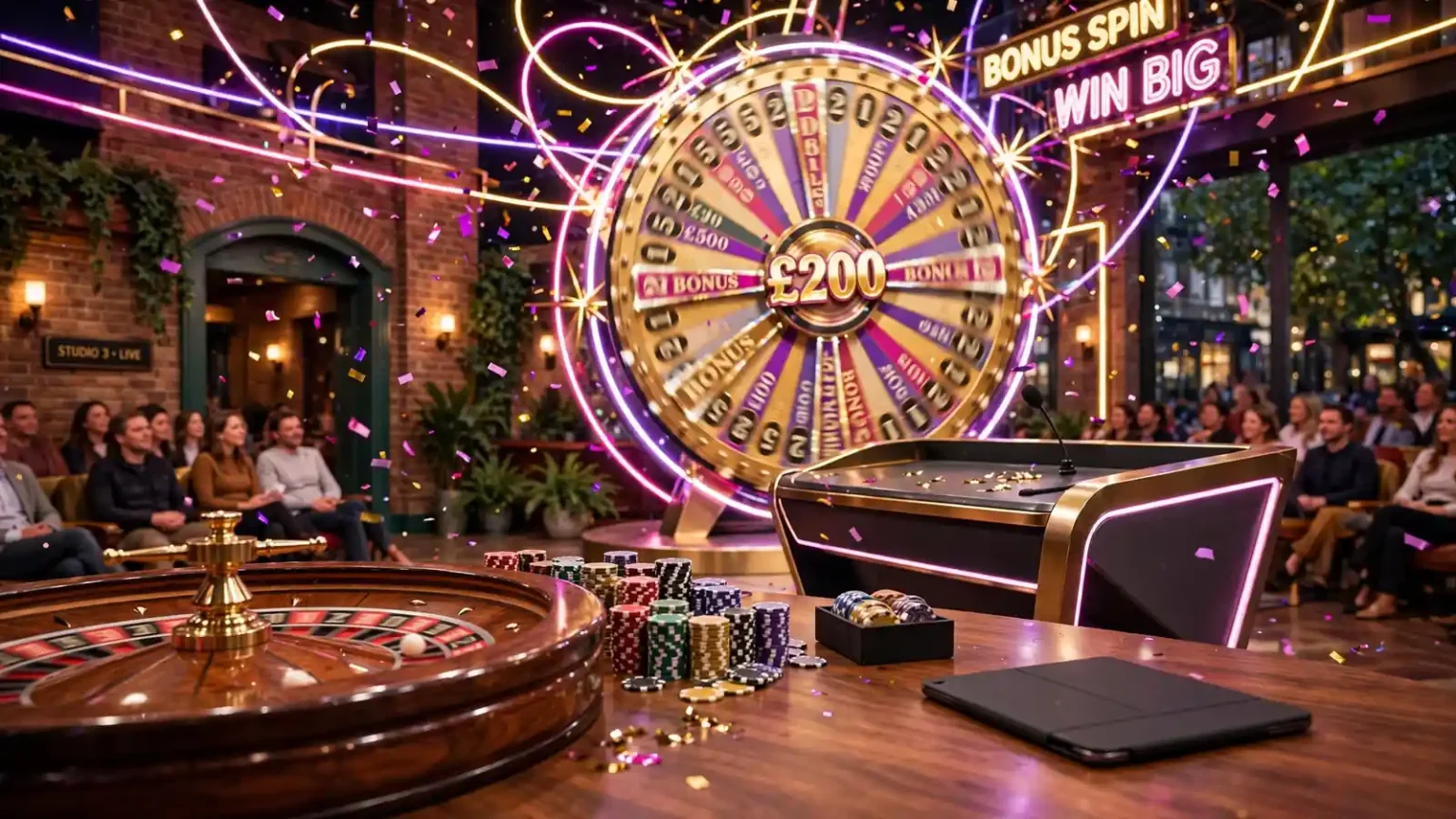
Explore the game-show format, casino checks, budgeting, demo play and the cash terms that can shape a Crazy Time session.
How Crazy Time Fits into a UK Live Casino
Crazy Time is a live casino game presented in a game-show style. Its place is alongside familiar table games, but its presentation is designed to feel more like a hosted studio event than a conventional digital table. That distinction matters: “live casino” describes the setting and presentation, while the individual game determines what participants actually play.
In a UK casino context, the live-casino category brings streamed games and a human host into an online environment. A player sees the activity as it unfolds rather than interacting only with a sequence of computer-generated screens. Crazy Time uses that broadcast format to give its game-show presentation a central role. The studio, host and visual elements are part of the product, not evidence that its outcomes can be anticipated or controlled.
This is also why Crazy Time can attract attention from people who do not begin with a specific interest in card games. A standard table layout may be easy to recognise, but it can appear formal or technical. A show-led format presents a different first impression: the entertainment is prominent, while the gambling remains the underlying activity. The distinction should not blur the financial one. Stakes are still money at risk, and the show does not change that.
Live casino is not a single game type. It is an online category that can contain traditional card and casino games as well as more theatrical formats. Grosvenor’s history offers a useful marker of how established the category is: the operator introduced live casino games in 2013, with Blackjack, Texas Hold’em and Roulette among its offering. Crazy Time belongs to the broader live-casino setting, but its show format gives it a different character from those familiar table titles.
The entertainment layer can make the game seem less like a conventional casino session. That is a presentation choice, not a change in the basic transaction: a wager is placed, and the result determines whether money is returned or lost. Music, hosting and visual effects may make the experience more engaging; none of them improves the value of a wager. Production can make an event feel vivid, but vividness is not a financial advantage.
Live Dream Catcher Casino UK: What to Verify
The term “Crazy Time live casino” therefore describes both a particular product and a way of presenting casino play. It is not a general label for every live table, nor does the game-show style make it equivalent to watching a programme without wagering. The financial element remains central even when the screen looks more like a studio set than a felt table.
For anyone assessing a Crazy Time casino in the UK, the useful starting point is this separation between format and substance. The format explains why the game looks different from conventional live tables. The substance is still gambling, offered within an online casino environment. The game’s presentation can be assessed as entertainment; the decision to wager should be assessed as a financial outlay that can be lost. Only money that can be afforded to lose should be used for gambling.
Recommended online casinos
- BritsinoBonus: Welcome Package – Get your £2,200 + 2,000 FS · Payout speed: 1-3 business days
- DieselwinBonus: Welcome Pack 250% up to £4000 + 200 FS · Payout speed: 1-3 business days
- WinBeastBonus: €5000 + 500 FS + €650 Freebet · Payout speed: 1-3 business days
- AmunbetBonus: Join now and get 450% up to 2,700 GBP + 450 FS · Payout speed: 1-3 business days
- ZombillionBonus: Welcome Pack 250% up to £4000 + 200 FS · Payout speed: 1-3 business days
- NightWinBonus: £900 + 400 free spins · Payout speed: 1-3 business days
- x3betBonus: Welcome Pack 100% Up to £1.000 + 200 Free Spins · Payout speed: 1-3 business days
- NightLuckBonus: Welcome Pack + 805% Up To 6400€ + 280 FS · Payout speed: 1-3 business days
- JetsetspinsBonus: 200% Bonus + 100 Free Spins + Free Royal Wheel · Payout speed: 1-3 business days
Finding Crazy Time at an Online Casino
Crazy Time may be listed among a casino’s live games rather than alongside standard online slots. The exact menu structure depends on the site: a live lobby might group games by format, provider or table type, while another may put them in a single catalogue. The useful starting point is the live-casino area, followed by the site’s own search or category controls.
A game tile is only a route into the listing, not proof that the game is currently available to an account. Search results can vary with the casino’s catalogue and the way its lobby is organised. If Crazy Time does not appear under a live-games heading, checking the site’s general game search is more informative than assuming the title is absent. A search may use the game’s full name, while category filters can narrow a crowded catalogue.
The listing itself can establish what the casino is presenting: the game title, its location in the lobby and any access indicator shown on screen. Before opening it, check that the result is the intended game rather than a similarly named product or a promotional tile. A banner may advertise a game without serving as its playable entry. The distinction is small in design and material in practice.
A game tile in the casino lobby is a route into the listing, not proof that the game is currently available to an account. Checking the site’s general game search is more informative than assuming the title is absent if it does not appear under a live-games heading.
Availability can also depend on the casino’s current offering and the account’s access. A title visible in general site content may not be present in the live lobby, and a listing may change over time. For that reason, claims that a particular casino is an online casino with Crazy Time need to be checked against the actual game catalogue, not inferred from a general live-casino page or a search result elsewhere.
Once opened, the game interface may sit within the casino’s own site or appear in a separate game window. In either case, the key practical checks are whether the title is clearly identified, whether the controls are legible, and whether the game loads without leaving the casino’s stated environment. If the display is unclear, returning to the lobby and opening the title from its listing is a cleaner check than relying on a saved link or an old page.
A live-casino lobby is not necessarily a static catalogue. Games may be arranged in featured rows, recently added areas or category pages, so the first screen is not the whole selection. Scrolling or using the site’s filters can help distinguish “not immediately visible” from “not listed”. If the casino provides a favourites function, it may make a previously located title easier to find later, though that convenience does not establish continued availability.
Search results deserve the same restraint as lobby labels. A casino page mentioning Crazy Time may be editorial, promotional or navigational rather than a playable listing. The clearest indication is a game entry that opens the title from within the casino’s live offering. Where the result leads to a general information page, the site has not yet shown that the game can be accessed there.
Deal or No Deal Casino UK: Slots and Format
Account access is a separate condition from finding the title. Operators must verify a customer’s age before allowing a deposit into a gambling account. The presence of a game in a public lobby does not remove that requirement, and a visitor should not treat a visible tile as confirmation that every account can proceed to play.
The same care applies to the phrase “Crazy Time casino online”. It describes a game sought within an online casino, not a special kind of account or a guarantee that every casino carries it. A useful check is therefore narrow: open the casino’s live-games area, search the title, and confirm that the listing leads to the game itself. Only money that can be afforded to lose should be used for gambling.
Checking a Casino’s UK Licence Before Depositing
A casino carrying Crazy Time is not, by that fact alone, authorised to take real-money play from customers in Great Britain. The relevant check is the operator’s legal status, not the game title, studio branding or appearance of a licence badge on a website. The UK Gambling Commission regulates commercial gambling in Great Britain, including remote gambling, and is the sole regulator for that activity. An operator serving customers there must hold the relevant Commission licence even if its servers or other key equipment are based elsewhere.
The Commission issues operating licences to businesses and personal licences to individuals working in regulated roles. For a casino account, the operating licence is the central question. A name in a footer is not enough: it could identify a group company, a software supplier or another business in the same corporate structure. The entity accepting deposits and providing the gambling service needs to match the licensed business.
License Verification
An operator serving customers in Great Britain must hold a relevant UK Gambling Commission licence. Depositing funds before confirming the operator’s legal status on the public register carries significant risk.
Search the public register
Before depositing, check the operator’s licence number against the UK Gambling Commission’s public register. The register is available through the Commission’s website. Search the business name shown in the casino’s terms and conditions, then compare the result with the company name and licence details displayed on the site. If the casino uses a trading name or operates through a different legal entity, the relationship should be clear in its published information.
A sound check connects the same operator across the register, the casino’s terms and the account or payment pages. A logo, copied licence number or general statement that a site is “regulated” does not establish that connection. If a number belongs to another business, or the registered company does not appear to operate the casino, the discrepancy needs resolving before money is sent.
The register is also a better reference than a search result or an advertisement. Those can point to a site without establishing who is responsible for the gambling service. A casino’s domain and brand may change, so the check should concern the current operator and the service actually being used, rather than an old review or a familiar name.
What a licence means in practice
A UKGC licence places the operator within the British regulatory system; it is not a guarantee that every decision or transaction will be satisfactory. It does, however, establish which regulator oversees the licensed activity and gives the customer a defined route for complaints. The Gambling Act 2005 governs gambling in England, Wales and Scotland. Northern Ireland has a different legal framework, so the scope of a Great Britain licence should not be casually described as covering every part of the UK.
Crash Casino Games in the UK: Rules and Risks
Licensed operators must provide an internal complaints process and access to an approved Alternative Dispute Resolution service. The casino’s terms should explain how to raise a complaint and identify the relevant ADR provider. The process matters because a complaint about account handling or a disputed transaction should be directed first through the operator’s stated procedure; unresolved cases can then be considered through the approved independent route, subject to its terms.
The casino should also provide safer-gambling controls, including self-exclusion. Account-level controls are not decorative settings: they form part of the operator’s obligations. New customers must be prompted to set a financial limit before their first deposit, and accessible controls must remain available for managing limits. Operators are also required to contribute to the Research, Education and Treatment levy.
Account protections to confirm
Age verification is required before an operator allows a customer to deposit funds into a gambling account. Online gambling is legal for adults aged eighteen and over where the operator holds a UK Gambling Commission licence. A site that accepts a deposit before completing the required age check is not following the expected process.
Payment methods also have restrictions. UK-licensed casinos cannot accept credit cards for gambling, including credit-card funding routed through a money service business. They cannot accept wallet payments where that wallet allows credit-card funds to be used for gambling. A payment option appearing on a cashier page does not override those rules.
UK Licence Check
- Identify the operator’s legal business name in the terms and conditions
- Verify the licence number on the UK Gambling Commission public register
- Confirm the registered company matches the entity accepting deposits
- Check for the availability of an internal complaints process and ADR provider
- Ensure safer-gambling controls and self-exclusion options are accessible
These checks are separate from assessing a game or deciding whether its terms are acceptable. They establish whether the business is authorised and whether the required complaint and account protections are available. The practical sequence is straightforward: identify the operator, confirm its current licence on the public register, and check that the casino’s published procedures match the protections expected of a UK-licensed service. If the business identity or licence cannot be reconciled, depositing is premature.
Where to Play: Live Casino Games and Providers
A casino’s live lobby is a catalogue of different formats, not a single table with a different name attached. Crazy Time sits in the live-game environment as a wheel-based show, alongside other products that may use cards, roulette wheels or studio-hosted formats. That distinction matters when comparing the range: a large count of titles does not necessarily mean a broad mix of ways to play.
The operator provides the casino account and organises its lobby; a game provider supplies the individual game. Those roles are separate. A live-casino catalogue can therefore include products from different providers, with distinct presentation and game formats. The provider name is useful for identifying a title, but it does not establish that every casino carries it or that the surrounding experience is identical at each venue.
For a player looking to play Crazy Time live, the relevant setting is the live-casino area rather than a general catalogue of digital casino games. A wheel game may be grouped under a live-show category, a provider’s collection or a broader live-casino filter. The precise layout depends on the operator. Category labels are navigation aids, not evidence that a particular game is available in every region or account.
Casino Dice Games in the UK: Rules and Risks
The wider selection gives useful context. Card tables such as blackjack and poker, roulette, and wheel or show games represent different formats, even where all are streamed from a live environment. A casino offering several formats gives a clearer basis for comparing the catalogue than one displaying repeated versions of a single game type. The comparison should concern what is actually listed and playable, rather than the headline number of titles.
Grosvenor provides a concrete example of how a live-casino range developed: it first introduced its live games in 2013, with card and casino options including Blackjack, Texas Hold’em and Roulette. That history shows the category is not limited to one game format. It does not, by itself, establish that Crazy Time is currently included in Grosvenor’s catalogue; game availability is a separate, changeable detail.
When assessing a live lobby, the useful checks are practical. Can the game be found by title, provider or format? Are comparable live games presented in the same area, making the scope of the catalogue visible? Does the lobby distinguish a live-streamed table or show from an automated game? These details help identify the environment without confusing a provider’s portfolio with an operator’s complete offering.
“Top” is not a meaningful description of a Crazy Time casino unless the basis for comparison is stated. A broader live selection may be relevant to someone who also wants card games or roulette, while someone focused on the wheel game may care more about whether the specific title appears and how clearly it is presented. The catalogue alone does not settle questions about account terms or customer protections; those require separate checks.
Live presentation can make a game feel like entertainment, but it remains gambling. Any amount wagered should be money that can be lost without affecting essential costs.
Attention: Live presentation can make a game feel like entertainment, but it remains gambling. Any amount wagered should be money that can be lost without affecting essential costs.
Evaluating a Crazy Time Casino Without a “Best Sites” List
A “best” label does not show what a Crazy Time casino will cost to use. A practical comparison starts with the terms attached to the account: what must be paid in, which payment methods are accepted, whether charges apply, and what conditions govern taking money back out. These details should be checked in the casino’s own terms before an account is funded. If a cost or condition is not stated clearly, it cannot be treated as zero.
The useful comparison is between the same items at each casino, rather than between promotional headlines. Record the deposit requirement, any transaction or currency-conversion charges, withdrawal conditions, and restrictions that could affect access to funds. Then compare the final position, not the size of a welcome offer. A larger advertised amount may have less practical value if its conditions make it harder to withdraw or use.
Account controls are part of the cost
A casino’s account controls matter because they affect how easily spending can be contained. Remote operators must prompt new customers to set a financial limit before their first deposit and provide accessible account-level limit controls. The relevant question is whether those controls are visible and usable from the account, rather than buried in general information. A limit has little operational value if it cannot be located when needed.
Age verification is also a condition of access to depositing: operators must verify a customer’s age before allowing funds to be deposited into a gambling account. This is not a promotional feature, but part of the account process. The terms should make clear what information or checks may be required and when the account can be used.
Mines Casino Game UK: Demo Play and Real Stakes
Payment methods should be examined as stated conditions, not treated as interchangeable. UK-licensed casinos cannot accept credit cards for gambling. Operators also cannot accept wallet payments where the wallet allows credit-card funds to be used for gambling. A payment route that appears convenient may therefore be unavailable for gambling deposits, depending on how it is funded. The practical comparison is the method’s actual eligibility and any stated charge, not its logo on a cashier page.
Compare the full offer, not the headline
Crazy Time casino bonuses can be assessed using the same arithmetic as any other offer: identify what is credited, what conditions attach to it, and what remains withdrawable after those conditions are met. The offer’s headline value is not the cash value. Terms may restrict eligible games, impose a deadline, or define when funds can be withdrawn; each condition changes the outcome. No promotion should be assumed to apply to Crazy Time unless its own terms say so.
This is also why a list of supposedly best Crazy Time casino sites would be a poor substitute for checking account terms. A ranking cannot establish whether a particular offer fits a player’s intended use or whether a payment condition changes its value. Compare written terms side by side, and treat unclear wording as unresolved rather than filling the gap with an assumption.
A useful record can be brief: account funding conditions, payment restrictions, offer conditions, and the location of spending controls. Those points reveal more about the practical arrangement than a “best casino” badge. They do not make gambling profitable or predictable. Only money that can be lost without affecting essential costs should be used for gambling.
Do
- Compare deposit requirements and withdrawal conditions side by side
- Check for the visibility and usability of account-level limit controls
- Verify if Crazy Time specifically contributes to wagering requirements
- Use only money that can be lost without affecting essential costs
Don’t
- Rely on “best sites” labels or promotional headlines for cost analysis
- Assume a welcome offer applies to Crazy Time without checking terms
- Use credit cards or credit-funded wallets for gambling deposits
- Treat a high headline bonus value as the actual cash payout
Crazy Time Strategy: Set a Budget, Not a Prediction
A workable Crazy Time casino strategy is a spending rule, not a method for identifying what will happen next. No betting pattern, record of previous rounds or casino tracker can turn past results into a reliable forecast. A tracker may organise information; it does not change the terms of the next wager.
The useful calculation begins before play: decide what amount can be lost without affecting rent, bills, food, savings or other commitments. That amount is the entertainment cost, not a target to recover or a balance that must be used. Gambling should involve only money that can be afforded to lose. If losing the full amount would create a financial problem, the amount is too high.
A budget also needs an endpoint. Without one, a spending limit can become an opening figure followed by successive top-ups. The stop point should remain fixed even after a losing run or a result that feels close to a recovery. Continuing to wager in order to win back earlier losses changes the original decision: it adds exposure without making those losses more recoverable.
A practical record can be simple. Note the amount set aside, the amount deposited, the total wagered and the balance remaining when play ends. These figures answer a financial question: how much of the planned entertainment cost has been used? They do not show that a particular outcome is due. A history of results, whether kept manually or displayed by a Crazy Time casino tracker, describes what has happened, not what the next round will produce.
Chicken Road Game Casinos in the UK: What to Know
That distinction matters because visible sequences invite interpretation. A run of similar outcomes can look like evidence of a trend; a long gap can look like a reason to expect a particular result. Neither observation supplies a dependable basis for increasing a wager. Treating a tracker as a prediction tool can make spending less controlled precisely when it appears more calculated.
The same caution applies to so-called Crazy Time casino strategies based on changing stake size. Increasing a wager after a loss raises the amount at risk; it does not erase the loss or establish that a reversal is imminent. Reducing a wager after a win does not preserve the win unless play actually stops. The only certain way to prevent further gambling losses in that session is to end it.
A budget is therefore better understood as a ceiling than a plan to spend every penny allocated. A session can finish earlier; the unused amount remains available for its intended purpose. Keeping gambling separate from borrowing, credit and essential household money helps preserve that boundary. A short record of actual spending is more useful than a detailed casino history interpreted as a signal.
The test for any proposed Crazy Time live casino strategy is straightforward: does it limit the amount exposed, or does it claim to predict outcomes? The first is a personal spending control. The second has no reliable basis in a record of previous play. When the budget is reached, stopping is the strategy.
Free Play and the Limits of a Demo
A free-play version can offer a way to become familiar with Crazy Time without putting cash into a gambling account. Its value is limited but clear: it can show how the game is presented and let someone explore the interface without a real-money stake. That is different from playing for cash, where a wager can be lost.
A free-play version allows users to explore the game interface and presentation without a real-money stake, but it does not establish that real-money play will produce the same financial experience.
Availability and conditions depend on the casino and the version it offers. A game page may provide a demo, require an account, or offer no free-play option at all. The word “free” is not enough to establish what access involves, whether play is restricted, or whether the experience matches the real-money version. Those details need to be checked on the relevant casino’s own page.
Free play should also be kept separate from free spins. A demo is a way to play without staking cash; free spins are an offer that may carry its own conditions. The names are not interchangeable, and the existence of one does not establish the availability of the other. No particular Crazy Time free-play feature or free-spins offer can be assumed across casinos.
A demo cannot establish that real-money play will produce the same experience in financial terms. There is no cash at risk in free play, so it does not show what a particular session would cost or return with real wagers. Nor does a run of demo outcomes provide a reliable basis for predicting future results. Familiarity with the screen is not a financial advantage.
Reviews can help identify what a casino says about its game access, but claims about a demo should be treated as descriptions to verify, not as a substitute for the actual terms displayed by the operator. A safe choice also depends on the casino itself, not merely on whether it has a no-cost version of a game.
Where real-money gambling follows, the central limit remains practical rather than technical: gambling money can be lost. Only money that can be afforded to lose should be used, and free play should not be mistaken for evidence that a cash session will be inexpensive.
Bonuses and Deposits: Read the Conditions as Cash Terms
A Crazy Time casino bonus is not extra cash until its conditions are met. A welcome offer may be described as a deposit match, bonus funds or a no-deposit promotion, but those labels do not establish that an offer exists for Crazy Time, or that its value can be withdrawn. The relevant figure is the amount ultimately available as cash, after any play-through conditions, game restrictions and expiry rules have been applied.
For a deposit bonus, compare the required deposit with the bonus credited and the conditions attached to both. Check whether Crazy Time contributes towards any wagering requirement, whether only selected games qualify, and whether the bonus must be used before a stated deadline. If the game is excluded or contributes less than other games, the advertised bonus value may have little practical relevance to someone intending to play Crazy Time. A larger headline figure is not a larger payout when the conditions make it inaccessible.
A no-deposit offer removes the initial cash deposit, not necessarily the conditions. Check whether registration, identity checks, eligible games or a withdrawal cap apply, and whether winnings must be played through before withdrawal. “No deposit” describes one part of the transaction; it does not mean unrestricted cash.
Deposit and withdrawal terms should be read together. Note the permitted payment route, any fees stated by the casino, and any withdrawal conditions linked to bonus funds. UK-licensed casinos cannot accept credit cards for gambling, including credit-card funds routed through a money service business or a wallet that allows credit-card funding. A payment route that appears convenient can therefore be unavailable for gambling.
Attention: UK-licensed casinos are prohibited from accepting credit cards for gambling, including funds routed through money service businesses or wallets that allow credit-card funding.
Before a first deposit, operators must prompt new customers to set a financial limit and provide accessible account-level limit controls. Age must also be verified before funds can be deposited. These are account conditions, not promotional extras.
A search for a Crazy Time casino bonus in the UK, including a no-deposit offer, does not establish that a suitable promotion is currently available. Compare the written terms with the intended deposit and the cash that could actually be withdrawn. Any amount wagered remains at risk; gambling should be limited to money that can be afforded to lose.
Rules, Multipliers and Great Britain Slot Stake Limits
Before wagering on Crazy Time, the rules should make clear how each round works, what choices are available and how any bonus feature is settled. Multiplier information matters because it explains how a winning outcome is calculated; a displayed multiplier is not, by itself, a forecast of the next result. Any score shown during play should be read as a record or outcome indicator, not evidence that a particular result is due.
The rules and the legal classification of a game are separate questions. Great Britain’s online slot stake limits concern games classified as online slots. A specialist review describes the limits as £2 per game cycle for adults aged 18 to 24 and £5 for adults aged 25 and over. The same type of review says those limits do not apply to roulette or blackjack. Those comparisons do not establish how Crazy Time is classified, so the slot limits should not be applied to it by assumption.
That distinction matters when reading the game information. Check the operator’s description of the game and the applicable rules for the round, including how a multiplier affects a settlement and what the score represents. If the game is treated as an online slot, the relevant stake limit depends on the player’s age; if it is not, the slot limit is not the right measure. A familiar live-casino presentation does not settle that classification.
The practical test is whether the rules explain the outcome clearly enough to calculate what a wager can return, while separating that calculation from any claim about future results. If the settlement terms or classification are unclear, the displayed score or multiplier cannot fill the gap. Gambling outcomes can result in a loss, so only money that can be afforded to lose should be wagered.
Trying a Crazy Time Demo Before Depositing
A Crazy Time demo is not something to assume is available at every casino. The game may be listed without a practice option, or a demo may be accessible only through a particular lobby or device. The practical check is whether the game page offers a clearly labelled demo or play-for-fun mode before an account is funded. If it does not, the listing alone does not establish that practice play is available.
A demo can familiarise someone with the screen layout, the sequence of a round and where the game displays its outcomes. It can also show how the live presentation works, though it cannot establish what real-money play will feel like or produce. Any credits shown in a practice mode should be treated as part of that mode, not as money available to withdraw.
Crazy Time is a live casino game, so “slot demo” is not a reliable description of what is being offered. A casino page may use broad labels for its games, but the relevant detail is whether the specific Crazy Time table has a non-cash practice option and what restrictions apply to it. Those conditions should be visible before use; a demo label by itself says little about access or functionality.
If no demo is provided, that is a limit on what can be tested in advance, not a reason to deposit to find out. Real-money gambling carries the possibility of losing the full amount wagered. Gambling should be limited to money that can be afforded to lose.
What are the online slot stake limits in Great Britain?
The limit is £5 per game cycle for adults aged 25 and over, and £2 for adults aged 18 to 24. These limits do not apply to roulette or blackjack.
Are online casino games licensed and regulated?
Yes. The UK Gambling Commission regulates remote gambling offered to consumers in Great Britain, and operators serving them must hold the relevant licence.
Is LuckyPays licensed by the UK Gambling Commission?
The Commission’s public register dated 26 September 2026 does not list LuckyPays under that brand or its stated domain, luckypays.io.
Material created by the team Skrill Casino UK Guide


